Your coaching business was never meant to become a content treadmill

A thoughtful coaching business can grow through trust, useful ideas and intentional email. Here is how to step off the treadmill without disappearing.
There is a version of running a coaching business that nobody quite warns you about.
You begin because you are good at helping people.
You know how to listen.
You notice what sits beneath the obvious problem.
And you ask the question that changes the direction of a conversation.
Then, somewhere along the way, the job expands.
You are expected to post. Film. Caption. Repurpose. Comment. Keep up. Turn the walk, the client insight, the awkward moment and the quiet Sunday daydream into something the algorithm can distribute.
A useful idea lands, and before you have even had time to think it through, another part of your brain is asking whether it should be a Reel or carousel.
Social media has value.
It can introduce good people to your work. It can show reach and interest. It can open doors.
The problem begins when your business feels as though it will stop moving the moment you stop feeding it.
That is a very expensive way to stay visible. The bill arrives in attention, creative energy and the nagging sense that nothing you make is ever allowed to be finished.
I've spent 13+ years writing copy, and I love a strong piece of content. But there's a difference between content creation and content strategy. Content creation can put you on a treadmill of never-ending content creation. Content strategy invites you to be more intentional about what you post, when you post and the end goal that your content is designed to achieve.
The way I see it, the best content lives on long after you publish it. It works hard to bring you leads, grow your business and increase sales. And it doesn't rely on you to feed the algorithm and become a content creator.
Your coaching business shouldn't need a new post every day to survive.
How the content treadmill became the business model you never agreed to
Most coaches do not sit down and choose permanent content production as a business model.
It happens by accident and social conditioning.
It's a bit like the way cereal companies helped cement the idea that breakfast was the most important meal of the day. A useful belief when you're selling cereal. Well...
The same is true with influencers, content creators and digital marketers... And yes, I'm aware that I fall into the third camp myself and have caught myself uttering the same marketing spiel as everyone else. But not anymore. Because here's the thing -
One platform rewards short video, so you make short video. Another expert says daily posting builds authority, so daily posting joins the plan. A launch feels quiet, so the answer becomes more top-of-funnel content. A week away creates a dip, which seems to prove that you cannot step away.
Before long, visibility has become the second job you never signed for.
And because you care about your business, you keep trying to do it properly.
You save hooks. You build a content calendar. You batch. You promise yourself you will repurpose more efficiently this month. You may even make it work for a while...
But there is a question worth asking before you colour-code your pristine Google Drive folder system again:
Do you want a business that needs this much feeding?
That question gives you permission to take a breath. To ask yourself if one channel - social media marketing - should carry such a large portion of your coaching business. Because in reality, you can keep using social media without letting it run your entire business.
Social media can help someone find you. But it's a bad idea to put all your eggs in one basket.
What constant visibility costs you, beyond time
The obvious cost is time.
The quieter cost is what the constant production hamster wheel does to your mindset.
You start judging an idea by how quickly it can become content. You start valuing what you post by external vanity metrics such as likes, comments and follows.
The subtle observation from a client conversation gets squeezed into a content idea.
The thought you are still working through gets published before it has roots to take hold.
You're not just sharing a story anymore; you're looking for an opening hook, the three key takeaways and a question for higher engagement.
The need to be always switched on and visible does this.
Experienced coaches often hold their best work differently.
They sit with patterns. They notice what keeps repeating across conversations. They change their mind when new evidence appears. Their value is rarely the sheer quantity of their ideas. It is the judgement shaped by years of using them with real people.
That kind of expertise deserves better than a daily demand for something new and a caption before lunch.
It also deserves a business model that recognises a simple truth: people may discover you because of one piece of content, but they choose to work with you after many smaller moments of trust.
A thoughtful email. A clear answer. A useful invitation. A sense that you understand the problem beneath the problem.
Quiet moments of trust are still the bedrock of building a business that people buy from. These moments need to be real and repeated often enough to make a difference in people's lives.
Start with the trust and expertise you already have
When the business feels slow, the instinct is often to add.
More followers. More leads. Another lead magnet. A new content pillar. A fresh platform where the reach still looks promising.
Sometimes more reach is useful. Sometimes the overlooked opportunity is already sitting inside the business.
You may have:
a list of people who chose to hear from you, even if you have not emailed them for a while;
years of questions clients have asked you;
phrases you use in sessions because they help something click;
workshops, notes, talks, podcast conversations and old emails;
offers built to solve a problem you understand intimately;
stories that explain why you work the way you do;
subscribers who know your name but have never been shown a clear next step.
These are evidence of trust, expertise and attention already earned. Not scraps waiting to be repackaged into more content to feed an algorithm that always wants the next post.
There is a more useful question than, “What can I create this week?”
Try this one instead:
What have I already learned, made or earned that deserves a deeper conversation?
The second question moves you from production to stewardship. You stop treating every week as an empty shelf to fill and start treating the business as a body of work. An ecosystem of intellectual property that you govern and chart in a direction that serves you and your clients.
Right. Now we can do something useful with it.
A trust-led way to grow your coaching business
Trust-led growth means building your business from the relationships, expertise and attention you have already earned, then using email to deepen them. It still asks you to communicate, make invitations and help new people find you.
You simply begin in a different place.
1. Start with the people, not the platform
Think about the people who have already raised their hands.
People who:
joined your list
attended a workshop
downloaded something useful
have replied before
open your emails
Enough curiosity will do. Ask what would help them take one honest next step.
2. Use what your client work is already teaching you
Your next useful idea may be hiding in a question you answered in client conversations this month.
It may be the assumption you keep gently correcting. The moment a client finally understood what was keeping her stuck. The part of your offer people regularly misunderstand. The thing you wish somebody had told you five years ago.
None of that requires a brainstorm called “content ideas”. It requires attention to the work you are already doing.
3. Give social media and email different jobs
Let social media help with discovery, conversation and public thinking.
Let email deepen the relationship.
An email can carry more context. It can sound like a note to one person. It can make a thoughtful invitation without competing with ten other posts on the screen. It reaches people who have already said yes to hearing from you.
That makes email a useful home for the ideas that deserve more than a passing scroll.
4. Make the invitation part of the service
Many coaches are comfortable teaching and less comfortable saying, “Here is how I can help.”
So the invitation gets softened until it is barely visible. The reader receives something useful but no direction.
If your work is relevant, clarity is kind.
You can explain who an offer is for, what it helps with, what happens next and who it will not suit. You can do that without pressure, invented urgency or pretending every reader needs to buy.
Trust is protected by honesty, not by hiding the offer.
5. Repeat the ideas that matter most
The content treadmill creates a hunger for novelty. Trust usually grows through recognition.
Your audience benefits from understanding the few beliefs that shape your work and seeing how those beliefs apply to their lives. A new worldview every newsletter day is optional.
When the idea matters, useful repetition helps your point of view become memorable.
What to email your list when you are tired of making content
If your mind has gone blank, do not ask it for “content”. That word can make a thoughtful person feel like a small factory.
Ask a narrower question, like the one above: What have I already learned, made or earned that deserves a deeper conversation?
Connect: share what you are noticing
What are you noticing in your own work or life that your readers might recognise in theirs?
You do not need a grand lesson. A clear observation, honestly told, can be enough.
Teach: answer the problem beneath the problem
What common problem do your clients face? What is happening underneath what they share? What do you wish they understood sooner?
Write the answer you would give in a coaching session.
Prove: show what changed for a client
What changed for a client, with her permission and with identifying details protected? What did she understand, decide or do differently?
Keep the focus on the change, not on turning her life into a marketing prop.
Invite: make the next step visible
Who is your offer for right now? What problem would make it timely? What can someone expect if she takes the next step?
Make the path visible. Let the reader decide.
Those four purposes are enough to build a rich email rhythm. They also remove the pressure to make every message perform every job at once.
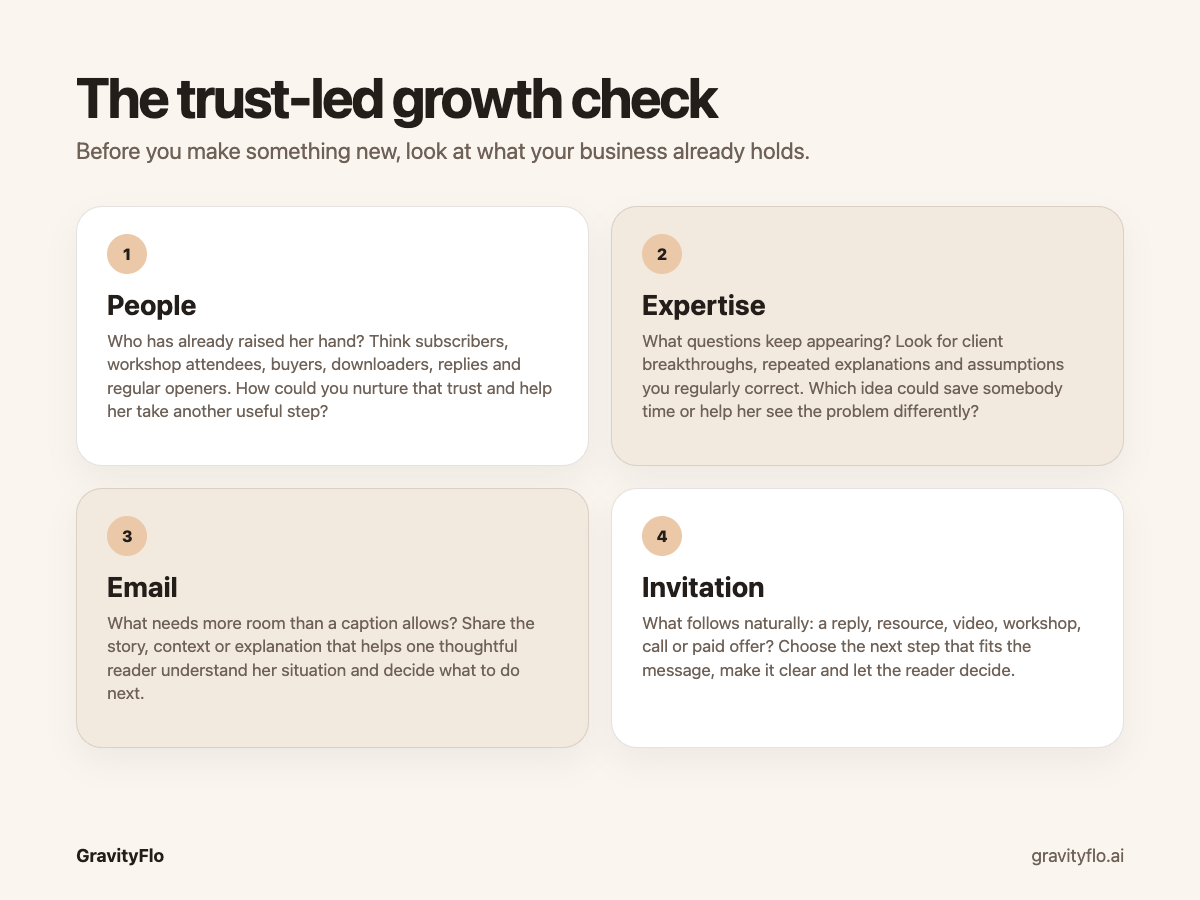
The trust-led growth check
Before you add another piece to the content calendar, ask:
People: who has already asked to hear from me?
Think beyond follower numbers. These are the people who joined your email list, downloaded a resource, attended a workshop, bought something from you, replied to a message or continue to open your emails. They have already shown curiosity or trust. How could you stay in contact and nurture that relationship rather than immediately chasing somebody new? What would help them take another useful step?
Expertise: what am I already noticing, teaching or answering?
Look at the questions that keep appearing in client conversations, the assumptions you regularly correct and the moments when something finally clicks for somebody. Which idea deserves more room? Which answer could save another person time, uncertainty or a wrong turn? Your next email may already exist inside work you have done this week.
Email: what deserves a deeper conversation away from the feed?
Social media can introduce an idea, but some subjects need more context than a caption allows. What story, distinction or explanation would help your reader see her situation differently? Could you answer one useful question, unpack a client pattern, share a decision from behind the scenes or explain the thinking behind an offer?
Invitation: what is the clearest useful next step for the right person?
The next step does not always need to be a sale. It might be replying to your email, downloading another resource, watching a useful piece of content, joining a workshop or booking a call. It may also be buying the offer you have just discussed. Choose the step that naturally follows the message, make it easy to understand and let the reader decide.
If you can answer those four, you have the bones of your next email. No faffing about with 47 hooks required.
Consistency without the volume: a sustainable email rhythm for coaches
Consistency has been confused with volume for so long that a gentler rhythm can feel like failure. A gentler rhythm can still be consistent.
Consistency means people can trust that you will return. It means your ideas have a recognisable centre. It means your invitations do not arrive from nowhere after months of silence.
But even when silence does happen (life happens, I get it), that's where re-engagement emails come in.
For one coach, that may mean one good email every week.
For another, two thoughtful emails a month with a short sequence around a workshop or programme.
During a launch, the rhythm may change again.
The right cadence is the one that serves your reader, supports the business and leaves enough of you for the work itself.
Here is a simple place to begin:
Choose one question you have answered recently.
Write the answer as though you are speaking to a potential client.
Add one clear next step, even if that next step is to simply reply to your email.
Send it to the people who already asked to hear from you.
Notice what comes back before deciding what to make next.
That is a business moving through relationship rather than relentless visibility.
And it is enough for today.
Still wondering whether you need to post every day?
Do you really need to post every day? What should you email when you have nothing to say? And what happens if your list has not heard from you for months?
Read five honest answers about growing a coaching business without constant content →
Want help turning the trust you have already earned into emails?
GravityFlo is being built for experienced female coaches who want to turn the expertise, stories and trust they already have into intentional emails, in their own voice and without feeding another content machine.
Join the free GravityFlo waitlist →
You will get early access updates and hear when the demo is ready. No payment or card details are needed to join.
P.S. Social media still has a seat at the table. It just doesn't need to occupy every chair.
About GravityFlo
GravityFlo is an email marketing platform for female coaches in life, wellness and personal transformation. It is being built by Drew and Natalie Milligan to help experienced coaches know what to say, write in their own voice and show up consistently without turning marketing into another full-time job.
GravityFlo helps her make more of the business material she has already created and turn it into purposeful emails in her own voice. She stays the author and can edit every email before anything is sent.
Join the free GravityFlo waitlist for early access updates and a first look at the demo.
About the author
Natalie Milligan is GravityFlo's co-founder and copy architect. She has worked in marketing for 20 years and has spent 13 of them writing copy and implementing marketing strategies for clients. She writes about email, trust-led marketing and building a business that does not require you to turn your whole life into a content machine.
