Five honest answers about growing a coaching business without posting every day

The pressure to stay visible can make normal marketing questions feel much bigger than they are.
Miss a week on social media and you wonder whether people will forget you exist.
Sit down to email your list and your mind suddenly empties.
Leave the list untouched for a few months and coming back begins to feel like knocking on the door of a stranger. Awkward
None of this means you are bad at marketing. It usually means you are trying to build a thoughtful business inside systems that reward speed, volume and permanent activity.
In Your coaching business was never meant to become a content treadmill, I shared a different starting point: grow from the trust, expertise and audience you already have.
Here are five questions that naturally follow on from there.
1. Can I grow a coaching business without posting on social media every day?
Yes.
Social media can help people discover you. But daily posting is not the only way to build trust or create sales. Referrals, partnerships, searchable content, speaking, workshops and email can all support growth.
The useful mix depends on where your audience already pays attention, what your business needs right now and what you can sustain without turning marketing into another full-time job.
Consistency does not have to mean daily. It means people can understand what you stand for, trust that you will return and see a clear way to stay connected when they want more.
2. Does this mean GravityFlo is anti-social-media?
Absolutely not.
Social media can be useful for discovery, conversation and testing ideas in public.
A thoughtful post can introduce the right person to your work. A conversation in the comments can show you what people are struggling to understand.
GravityFlo's position is simply that your business should not depend on permanent social visibility.
Social media can make the introduction.
Email gives interested people a direct way to stay connected after they discover you. One is not required to replace the other. They can do different jobs.
3. What should a coach email when she has nothing to say?
Begin with the work already happening.
Answer a question a client asked.
Explore a pattern you keep noticing.
Clarify a mistaken assumption.
Share a useful decision or explain why you created an offer.
You could also ask:
What have I explained more than once this month?
What do clients often believe before they work with me?
What changed for somebody once she saw the problem differently?
What would help the right person take one useful next step?
You often need a new reframe, not a brand new idea.
4. How often should a coach email her list?
Choose a rhythm you can keep and that matches your current business goal.
2-3 times a week can work well for an active coaching business. But one well-crafted weekly newsletter can be equally powerful. During a launch or event, you may email more often than usual because the reader needs timely information. That makes sense. During a quieter period, the rhythm may soften again. The cadence is yours to make but consistency is key.
The best schedule is not the one an internet guru told you to follow. It is the one that serves your reader, supports the business and leaves enough of you for the actual coaching.
5. How do I email my list again after months of silence?
Come back.
And do it without turning the gap into a confession.
Acknowledge it briefly if that feels natural, then give the reader something useful and tell her what she can expect next. You do not need a dramatic comeback speech, a detailed account of where you have been or an apology that takes up half the email. Yawn
A sincere reason to return will carry far more weight than an elaborate apology.
You might begin with a question you have been thinking about, a pattern from your recent work or a useful resource that gives the reader a reason to welcome you back. Then choose a rhythm you can actually continue.
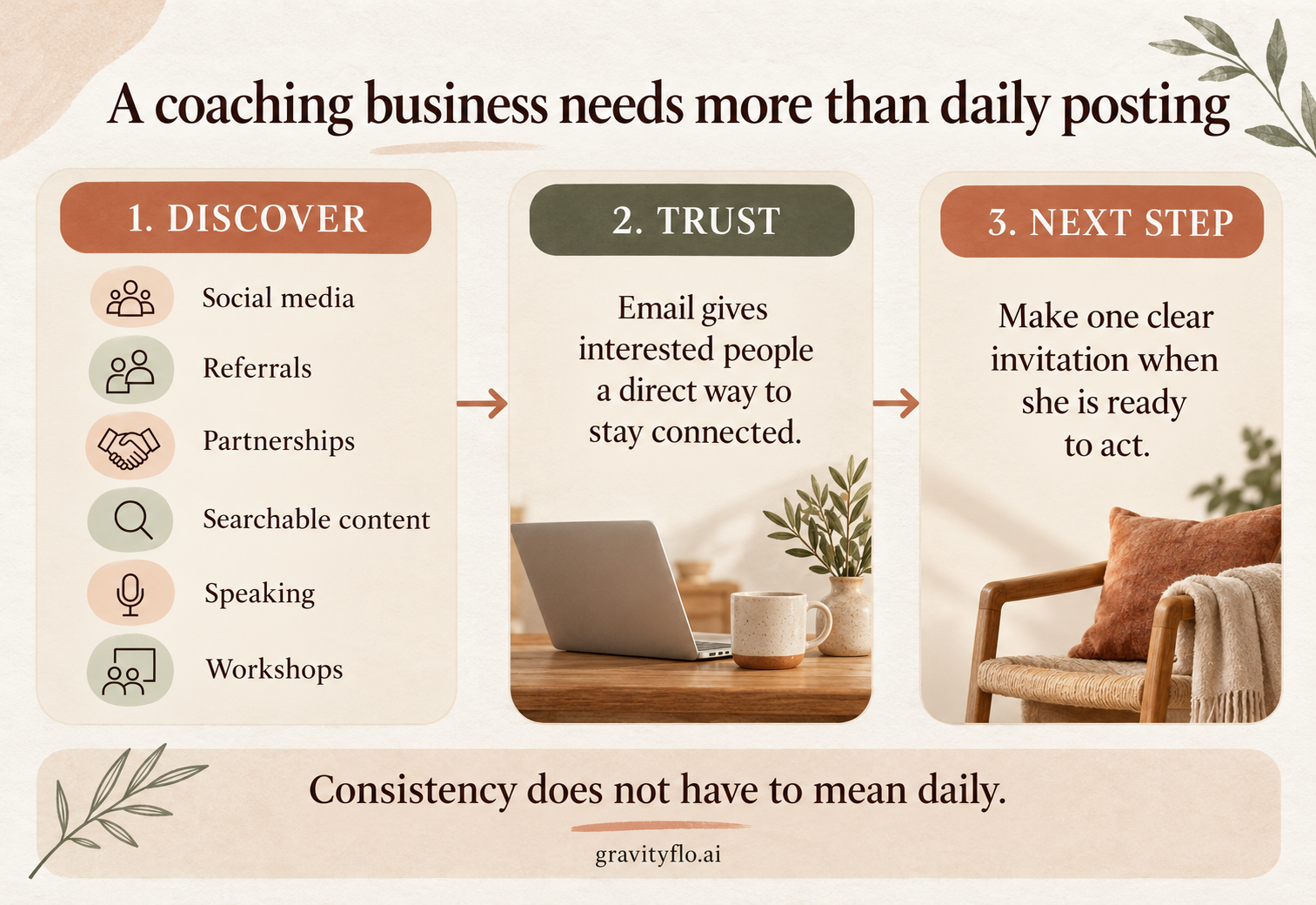
The short version: what a coaching business needs instead of daily posting
You do not need to become a full-time content creator to run a successful coaching business.
You need ways for the right people to discover you, reasons for them to trust you and a clear next step when they are ready to take action. Social media can support that, for sure. Email can deepen it. Referrals, partnerships, workshops and searchable work can all play their part too.
The aim is not to disappear. It is to build a business that does not fall silent the moment you take your foot off the content treadmill.
Want a calmer way to stay in touch with the people who already trust you?
GravityFlo is being built for experienced female coaches who want to turn the expertise, stories and trust they already have into intentional emails, in their own voice and without feeding another content machine.
About GravityFlo
GravityFlo is an email marketing platform for female coaches in life, wellness and personal transformation. It is being built by Drew and Natalie Milligan to help experienced coaches know what to say, write in their own voice and show up consistently without turning marketing into another full-time job.
About the author
Natalie Milligan is GravityFlo's co-founder and copywriter. She has worked in marketing for 20 years and has spent 13 of them writing copy. She writes about email, trust-led marketing and building a business that does not require you to turn your whole life into content.
Frequently asked questions
Can I grow a coaching business without posting on social media every day?+
Yes. Social media can help people discover you. But daily posting is not the only way to build trust or create sales. Referrals, partnerships, searchable content, speaking, workshops and email can all support growth. The useful mix depends on where your audience already pays attention, what your business needs right now and what you can sustain without turning marketing into another full-time job. Consistency does not have to mean daily. It means people can understand what you stand for, trust that you will return and see a clear way to stay connected when they want more.
Does this mean GravityFlo is anti-social-media?+
Absolutely not. Social media can be useful for discovery, conversation and testing ideas in public. A thoughtful post can introduce the right person to your work. A conversation in the comments can show you what people are struggling to understand. GravityFlo's position is simply that your business should not depend on permanent social visibility. Social media can make the introduction. Email gives interested people a direct way to stay connected after they discover you. One is not required to replace the other. They can do different jobs.
What should a coach email when she has nothing to say?+
Begin with the work already happening. Answer a question a client asked. Explore a pattern you keep noticing. Clarify a mistaken assumption. Share a useful decision or explain why you created an offer. You could also ask: What have I explained more than once this month? What do clients often believe before they work with me? What changed for somebody once she saw the problem differently? What would help the right person take one useful next step? You often need a new reframe, not a brand new idea.
How often should a coach email her list?+
Choose a rhythm you can keep and that matches your current business goal. 2-3 times a week can work well for an active coaching business. But one well-crafted weekly newsletter can be equally powerful. During a launch or event, you may email more often than usual because the reader needs timely information. That makes sense. During a quieter period, the rhythm may soften again. The cadence is yours to make but consistency is key. The best schedule is not the one an internet guru told you to follow. It is the one that serves your reader, supports the business and leaves enough of you for the actual coaching.
How do I email my list again after months of silence?+
Come back. And do it without turning the gap into a confession. Acknowledge it briefly if that feels natural, then give the reader something useful and tell her what she can expect next. You do not need a dramatic comeback speech, a detailed account of where you have been or an apology that takes up half the email. Yawn. A sincere reason to return will carry far more weight than an elaborate apology. You might begin with a question you have been thinking about, a pattern from your recent work or a useful resource that gives the reader a reason to welcome you back. Then choose a rhythm you can actually continue.
